Dottoressa in Pianificazione territoriale, urbanistica e paesaggistico-ambientale/Politecnico di Torino
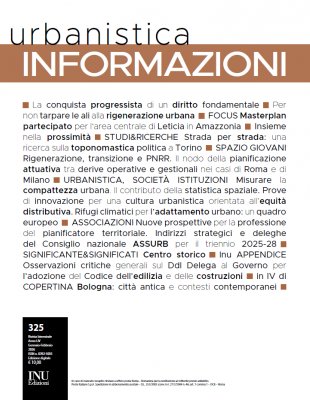
L’articolo analizza il tema dei rifugi climatici nel contesto delle politiche europee di adattamento, evidenziando il loro ruolo nel mitigare gli effetti degli eventi estremi. Il contributo esamina diversi modelli di intervento, mettendo in luce approcci nazionali e locali. Il testo sottolinea la necessità di politiche integrate e di una governance multilivello capace di coordinare azioni e risorse. I rifugi climatici vengono interpretati come dispositivi chiave per la resilienza urbana e la tutela delle fasce più vulnerabili della popolazione.
Antikainen R., Ahlola K., Jääskeläinen T. (2017), “Experiences as a means towards sustainable societies – Lessons learnt and future outlooks from a Finnish perspective”, Journal of Cleaner Production, vol. 169, p. 216-224. https://doi.org/10.1016/j.jclepro.2017.06.184
Barnes C., Konstantinoudis G., Masselot P., Mistry M., Gasparrini A. et al. (2025), “Summer heat deaths in 854 European cities more than tripled due to climate change”, Grantham Institute report. [https://doi.org/10.25560/123873]
Bauer A., Feichtinger J., Steurer R. (2012), “The Governance of Climate Change Adaptation in 10 OECD Countries: Challenges and Approaches”, Journal of Environmental Policy & Planning, vol. 14, no. 3, p. 279-304. https://doi.org/10.1080/1523908X.2012.707406
Biesbroek G. R., Swart R. J., Carter T. R., Cowan C., Henrichs T. et al. (2010), “Europe adapts to climate change: Comparing National Adaptation Strategies”, Global Environmental Change, vol. 20, no. 3, p. 440-450. https://doi.org/10.1016/j.gloenvcha.2010.03.005
Caldarice O. (2025), “Rifugio climatico”, Urbanistica Informazioni, no. 321, p. 116-116.
Caldarice O., Tollin N., Pizzorni M. (2021), “The relevance of science-policy-practice dialogue. Exploring the urban climate resilience governance in Italy”, City, Territory and Architecture, vol. 8, no. 1, p. 9. https://doi.org/10.1186/s40410-021-00137-y
Caldarice O., Pincigher B., Pizzorni M., Tollin N. (2025), “Urban Climate Shelters: a nature-based solution for urban resilience”, in C. M. Firoz, L. K. Dashora, R. Shaw (Eds.), Nature-Based Solutions for Urban and Peri-Urban Areas, Springer, Singapore.
Chan T., Mehryar S., Podesta M., Beswick A. (2026), Climate change adaptation laws and policies: a review of trends, gaps and opportunities in 35 countries, Grantham Research Institute on Climate Change and the Environment, London. [https://www.lse.ac.uk/granthaminsti...]
Dupuis J., Biesbroek R. (2013), “Comparing apples and oranges: The dependent variable problem in comparing and evaluating climate change adaptation policies”, Global Environmental Change, vol. 23, no. 6, p. 1476-1487. DOI: 10.1016/j.gloenvcha.2013.07.022
Redman C. L., Faeth S. H., Golubiewski N. E., Redman C. L., Wu J. et al. (2008), “Global Change and the Ecology of Cities”, Science, vol. 319, no. 5864, p. 756-760. DOI: 10.1126/science.1150195
Heidrich O., Reckien D., Olazabal M., Foley A., Salvia M. et al. (2016), “National climate policies across Europe and their impacts on cities’ climate strategies”, Journal of Environmental Management, vol. 168, p. 36-45. DOI: 10.1016/j.jenvman.2015.11.043
Leitner M., Johnson K., Lexer W., Munck af Rosenschöld J., Dworak T. et al. (2024), Characteristics and conditions of adaptation policy in European Environment Agency member and cooperating countries, European Topic Centre on Climate Change Adaptation and LULUCF Report 2024/2. [https://doi.org/10.25424/mccc-gppc-8542]
Magni F. (2019), Climate proof planning: l’adattamento in Italia tra sperimentazioni e innovazioni, FrancoAngeli, Milano.
Pincegher B., Pizzorni M., Caldarice O., Tollin N. (2025), “Urban Climate Shelters to Adapt Cities to Climate Change. A Proposal for Schoolyards in Turin (Italy)”, in F. Mosca, G. Oneto, Designing Resilience. Strategies for the sustainable development and understanding of urban complexity, Genova University Press, Genova, p. 164-177.
Reckien D., Salvia M., Heidrich O., Church J. M., Pietrapertosa F. et al. (2018), “How are cities planning to respond to climate change? Assessment of local climate plans from 885 cities in the EU-28”, Journal of Cleaner Production, vol. 191, p. 207-219. DOI: 10.1016/j.jclepro.2018.03.220
Scharpf F.W. (2000), Notes toward a theory of multilevel governing in Europe, Max-Planck-Institut für Gesellschaftsforschung, Köln.
Usman S., Parker M., Vallat M. (2025), Dry-roasted NUTS: early estimates of the regional impact of 2025 extreme weather. [https://dx.doi.org/10.2139/ssrn.5484206]
Van Oorschot J., Sprecher B., Van ’T Zelfde M., Van Boedegom P.M., Van Oudenhoven A.P.E. (2021), “Assessing urban ecosystem services in support of spatial planning in the Hague, the Netherlands”, Landscape and Urban Planning, vol. 214, p. 104195. DOI: 10.1016/j.landurbplan.2021.104195